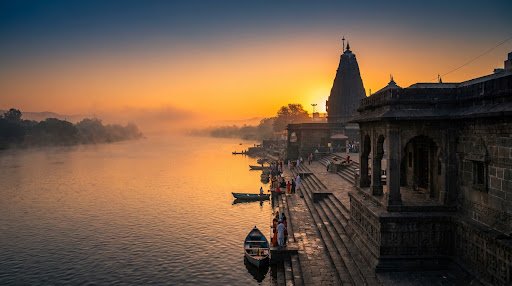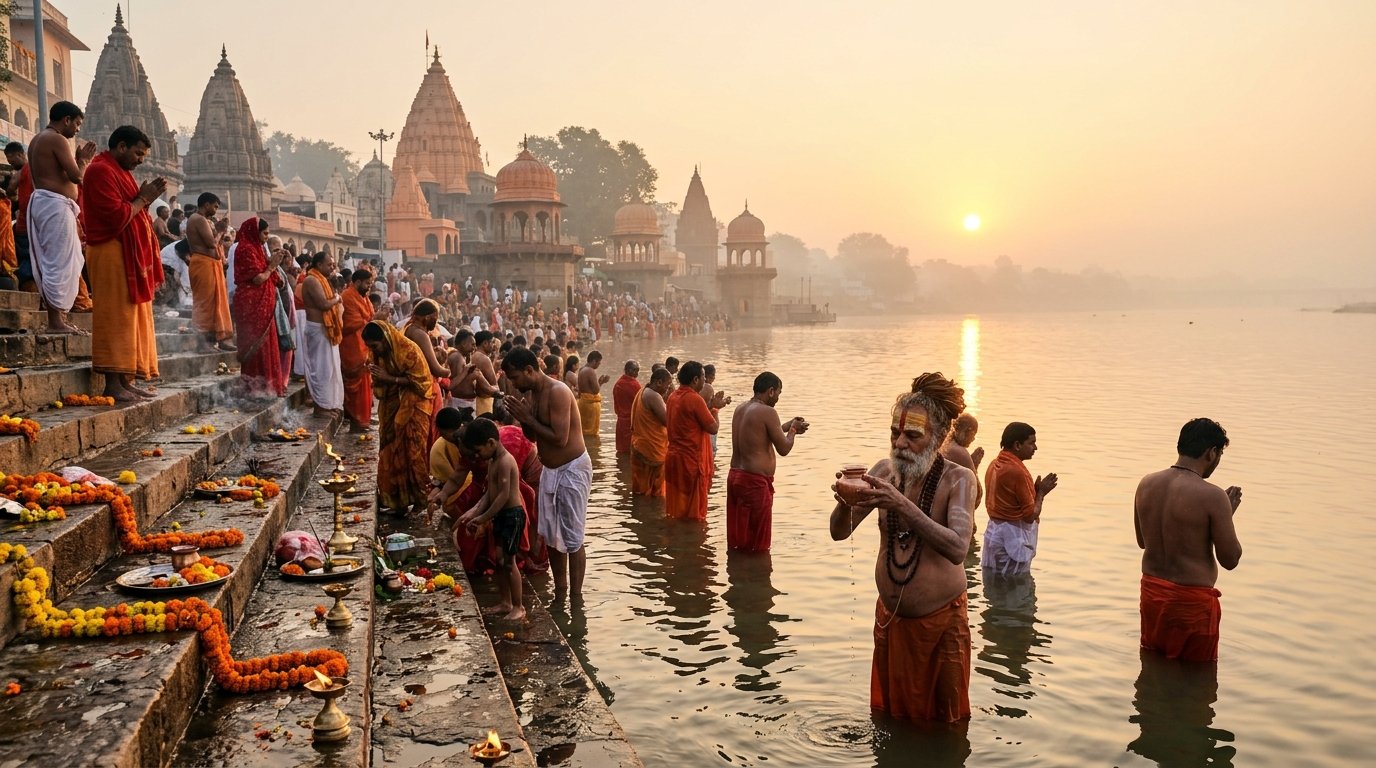
Before the first golden ray of dawn breaks over the red-brick chhatris of Avantika, a silence descends upon the ancient stone stairways of Ram Ghat.
The morning mist curls lazily across the tranquil surface of the Shipra River (Kshipra). Temple bells from the distant spires of the Mahakaleshwar Jyotirlinga begin their sacred cadence, mingling with the low hum of Sanskrit hymns whispered by ochre-robed ascetics standing chest-deep in the flowing currents.
To the casual onlooker, this is a timeless portrait of Indian devotion. But to the Vedic sage, the yogic initiate, and the modern seeker who digs beneath the surface, a holy bath at Ram Ghat is an act of sophisticated spiritual science.
Why has this specific stretch of the Shipra River drawn emperors, rishis, Shankaracharyas, and millions of Kumbh pilgrims across millennia? What cosmic geometry makes bathing here distinct from any other river in the world?
In this comprehensive guide, we unlock the astronomical secrets, Puranic legends, and bio-energetic mechanics that make a holy dip at Ram Ghat one of the most auspicious spiritual practices on Earth.
1. Sacred Coordinates: Avantika, Time, and the Tropic of Cancer
To understand the spiritual potency of the Shipra River, one must first look at the unique terrestrial location of Ujjain (known in antiquity as Avantika, Ujjayini, or Kanakashringa).
                 THE COSMIC ENERGY GRID OF UJJAIN
                 ================================
                          North (Kailash)
                                ▲
                                │
   Surya Siddhanta              │              Tropic of Cancer
   Madhyarekha (Zero Meridian)  │              (Karka Rekha / 23.5°N)
               │                │                        │
  ─────────────┼────────────────┼────────────────────────┼────────────
               │                │
               │         [ RAM GHAT ]
               │    (Shipra River Confluence)
               │                │
               ▼                ▼
                     MAHAKALESHWAR TEMPLE
                     (Lord of Time & Space)
The Ancient Greenwich of Vedic Astronomy
Thousands of years before Greenwich, England was arbitrarily selected as the Prime Meridian in 1884, classical Indian astronomers—including Varahamihira (in the Panchasiddhantika) and Bhaskaracharya—recognized Ujjain as the Madhyarekha (Zero Meridian of Hindu Astronomy).
The Surya Siddhanta, the world’s most ancient surviving treatise on astronomy, clearly records:
“The meridian of the world passes directly through Lanka at the equator, across Avantika (Ujjain), Kurukshetra, and up to Mount Meru in the far north.”
In the esoteric geography of Bharatavarsha, Ujjain represents the Nabhi-desha—the energetic “Navel Chakra” (Manipura) of the planet. Just as the navel connects a mother to her unborn child, channeling nourishment and life-force, the geo-magnetic axis at Ujjain is said to channel heightened cosmic frequencies straight into the Earth’s subtle energy grid.
The Intersection with the Tropic of Cancer
Ujjain is one of the rare places on the planet where the Zero Meridian of sacred astronomy intersects the Tropic of Cancer (Karka Rekha).
This astronomical intersection means that during the Summer Solstice and specific celestial transits, the Sun sits directly overhead at a 90-degree angle, bathing the region in unfiltered solar and cosmic radiation. It is here that Mahakaleshwar reigns as the conqueror of Time (Kala) and Death (Mrityu), and right by his side flows Mother Shipra.
2. The Descent of Shipra: Why She is Called Amritasambhava
In the Skanda Purana (specifically the celebrated Avantika Khanda), an entire volume is dedicated to the glory of the Shipra River. The texts reveal that Shipra is not an ordinary drainage basin; she is an Avatara of celestial grace, known by sacred titles such as:
- Papanashini: The instantaneous eraser of accumulated karmic debits.
- Amritasambhava: She whose current was sanctified by the drops of celestial immortality nectar.
- Punyasala: The fountainhead of spiritual merit.
                  THE PURANIC ORIGIN OF SHIPRA
                  ============================
                      Samudra Manthan
                            │
               Lord Dhanvantari with Golden Kumbh
                            │
                   Cosmic Pursuit by Asuras
                            │
             Garuda takes flight across the realms
                            │
        ┌─────────────┬─────┴───────────┬─────────────┐
        ▼             ▼                 ▼             ▼
    Prayagraj      Haridwar          UJJAIN         Nashik
     (Sangam)      (Ganga)       (SHIPRA RIVER)   (Godavari)
                                        │
                               [ Droplet of Amrita ]
                                        │
                           Waters transmuted into Nectar
The Splashing of Amrita
During the grand cosmic churning of the Milk Ocean (Samudra Manthan), the divine physician Lord Dhanvantari emerged with the Kumbha containing Amrita. As the celestial eagle Garuda carried the nectar to safety, pursued by the Asuras, drops spilled at four earthly sanctuaries: Prayagraj, Haridwar, Nashik, and Ujjain on the banks of the Shipra River.
The moment that single drop of celestial elixir melded with Shipra’s stream, her waters were invested with an unceasing spiritual life-force. Every twelve years, when the planets return to the exact astrological coordinate of that cosmic event, this dormant potency awakens fully, giving birth to the Ujjain Simhastha Kumbh Mela.
The Mystery of the Northward Flow (Uttara-Vahini)
In classical hydrological science, rivers flow toward the lowest topographical gradient. However, in sacred Vedic hydrology, the direction of river flow carries profound energetic significance.
Along key stretches of Ujjain—particularly at Ram Ghat—the Shipra adopts an Uttara-vahini (northward-flowing) course toward the Himalayas.
In Yogic physiology:
- South-flowing water (Dakshina-vahini) represents the downward dissipation of energy toward the underworld (Patala or the realm of Yama).
- North-flowing water (Uttara-vahini) mirrors the ascent of Kundalini Shakti through the Sushumna Nadi toward the crown (Sahasrara).
Bathing in a north-flowing sacred river actively draws the practitioner’s bio-electric currents upward, aiding in mental stillness, sensory mastery (Pratyahara), and deep contemplation.
3. The Treta Yuga Connection: Why Ram Ghat is the Holiest Threshold
Among the dozens of ghats lining the Shipra—from Mangalnath Ghat to Narsingha Ghat, Siddhavat Ghat to Triveni Sangam Ghat—Ram Ghat remains the spiritual crown jewel of Ujjain.
    CHRONOLOGY OF RAM GHAT'S SACRED SANCTIFICATION
    ==============================================
    TRETA YUGA
    Lord Rama, Sita & Lakshmana arrive in Avantika during exile.
    Rama performs Pitru Tarpan for Emperor Dasharatha at this ghat.
         │
         ▼
    DVAPARA YUGA
    Lord Krishna & Balarama bathe here daily during their studies
    at Guru Sandipani's Ashram in Avantika.
         │
         ▼
    KALI YUGA (HISTORICAL ERA)
    Adi Shankaracharya establishes the monastic order of Akharas.
    Ram Ghat designated as the prime seat for Shahi Snan.
         │
         ▼
    MODERN ERA / UJJAIN 2028
    The epicenter of the world's largest gathering of seekers.
The Pitru Tarpan of Lord Rama
The historical and spiritual primacy of this ghat traces directly back to the Ramayana. During their fourteen years of forest exile (Vanvas), Lord Rama, Mata Sita, and Lakshmana journeyed through the holy forest tracks of Malwa.
When news arrived of the demise of Emperor Dasharatha, Lord Rama sought a sanctum so pure that ancestral offerings would reach the highest spiritual planes without obstruction. Guided by the rishis, Lord Rama stood upon these very stone banks of the Shipra and performed the sacred Pind Daan and Tarpan for his father.
The Valmiki Ramayana and local sthala puranas state that Emperor Dasharatha’s spirit manifested above the waters, fully liberated from all ancestral bonds, blessing the ghat for eternity.
Because Lord Rama infused this site with his divine Sankalpa (spiritual intention), any bath or ancestral oblation performed at Ram Ghat carries a thousand-fold multiplication of merit, dissolving generational Pitru Dosha and liberating departed ancestors into higher dimensional realms (Pitru Loka and Vaikuntha).
4. The Spiritual Science & Biophysics of the Holy Snan
Why must one immerse their entire body in the river? Why not simply sprinkle a few drops of water on the head?
The Vedic science of Snana (ritual ablution) operates on physiological, bio-energetic, and subtle-karmic planes simultaneously.
                 THE THREE LEVELS OF PURIFICATION (TRISNAN)
                 ==========================================

     1st DIP: ADHI-BHAUTIKA (Physical Body & Bio-Stress)
     --------------------------------------------------
     Neutralizes static electromagnetic charges, cools core temperature,
     activates the vagus nerve via hydrostatic pressure.

     2nd DIP: ADHI-DAIVIKA (Pranic Sheath & Emotional Body)
     -----------------------------------------------------
     Realigns the 72,000 Nadis through water's negative ion charge;
     washes away subconscious psychic fatigue and astral debris.

     3rd DIP: ADHY-ATMIKA (Causal Sheath & Karmic Impressions)
     --------------------------------------------------------
     Through sacred Vedic Sankalpa, creates a quantum shift in the
     Chitta (mind-stuff), dissolving the seed-knots of past karmas.
1. Water as a Liquid Crystalline Memory Matrix
Modern physics and biophysical research (notably the work of Dr. Gerald Pollack on the “Fourth Phase of Water” or Exclusion Zone / EZ water) have demonstrated that water is not an inert chemical compound ($H_2O$), but a dynamic, liquid-crystalline medium capable of organizing into structured molecular lattices that store and transmit vibrational information.
For tens of thousands of years, the bedrock of Ram Ghat has absorbed:
- The rhythmic chanting of the Maha Mrityunjaya Mantra and Vedic suktas from adjacent temples.
- The sacred ash (Bhasma) from the Mahakaleshwar temple offerings.
- The focused devotion and high-frequency Sankalpas of enlightened masters, Naga sadhus, and sincere pilgrims.
When a devotee steps into this water, their bodily fluids (which comprise over 70% of human physiology) undergo entrainment—harmonizing with the coherent molecular geometry of the consecrated river.
2. Dawn Ionization & Brahma Muhurat
The scriptures mandate that the most auspicious time for a bath at Ram Ghat is during Brahma Muhurat (roughly 96 minutes before sunrise, between 4:00 AM and 5:30 AM) or at the exact instant of Suryodaya (sunrise).
During these twilight minutes:
- Cosmic gamma and ultraviolet rays interacting with the upper atmosphere produce a surge in atmospheric negative air ions along open bodies of moving water.
- Negative ions enhance oxygen flow to the brain, stimulate cellular repair, and induce high-amplitude alpha brainwave states associated with deep peace and heightened intuition.
- Stepping into cool river water causes immediate peripheral vasoconstriction followed by rebound vasodilation, activating the dive reflex and strengthening cardiovascular tone.
3. The Science of Surya Arghya (Solar Resonance)
A holy snan at Ram Ghat is incomplete without the offering of Surya Arghya—standing chest-deep in water and pouring a continuous stream of river water back into the current from a pure copper vessel (Tamra Patra), looking directly through the falling water toward the rising sun.
       Sunlight (Visible Spectrum + Subtle Prana)
                     \   \   \
                      \   \   \
                       ▼   ▼   ▼
               [ Stream of Falling Water ]  <--- Prism / Optical Filter
                       │   │   │
                       ▼   ▼   ▼
            Strikes the Ajna Chakra (Third Eye) & Heart
When sunlight passes through the cascading sheet of water:
- The water stream acts as an optical prism, refracting sunlight into its full prismatic spectrum.
- The refracted light softens harmful direct rays while concentrating beneficial bio-photons.
- As these photons strike the Ajna Chakra (between the eyebrows) and the optic nerve, they stimulate the pineal gland, optimizing melatonin synthesis and synchronizing the pilgrim’s circadian rhythm with nature’s cosmic clock.
5. Comparative Matrix: Ram Ghat vs Other Major Kumbh Sanctums
To appreciate the distinct character of Ram Ghat, examine how it compares with the primary bathing ghats across the four Kumbh Mela pilgrimages:
| Feature / Dimension | Ram Ghat (Ujjain) | Ramkund (Nashik) | Har Ki Pauri (Haridwar) | Triveni Sangam (Prayagraj) |
|---|---|---|---|---|
| Sacred River | Shipra River (Uttara-vahini) | Godavari River (Dakshina Ganga) | Ganga River (Himalayan Descent) | Confluence of Ganga, Yamuna & Saraswati |
| Cosmic Ruler | Lord Mahakaleshwar (Lord of Time) | Lord Trimbakeshwar (Three-Eyed Shiva) | Lord Vishnu (Footprint at Brahmakund) | King of Tirthas (Tirtharaj Prayag) |
| Astronomical Anchor | Zero Meridian & Tropic of Cancer | Jupiter in Leo (Simha Rashi) | Jupiter in Aquarius, Sun in Aries | Jupiter in Taurus, Sun & Moon in Capricorn |
| Primary Karmic Focus | Pitru Mukti & Instant Karma Dissolution | Absolution of deep generational curses (Gau-Hatya) | Liberation (Moksha) & Sannyasa Vows | Total rebirth & spiritual transcendence |
| Epic Period Legacy | Lord Rama’s Tarpan for King Dasharatha | Lord Rama’s exile cottage (Panchavati) | King Bhagiratha’s penance | Cosmic creation site of Lord Brahma |
| Next Mega Kumbh | 2028 (Simhastha Kumbh) | 2027 (Simhastha Kumbh) | 2033 (Maha Kumbh) | 2025/2037 (Maha Kumbh) |
6. The Evening Shipra Maha Aarti: When Fire Greets Water
While the dawn bath at Ram Ghat is introspective and purifying, twilight transforms the ghat into a breathtaking theater of cosmic devotion.
Every evening at sunset, the Shipra Maha Aarti is conducted with towering multi-tiered brass lamps (Deepastambhas) held aloft by Vedic priests dressed in crimson and gold.
                       THE COSMIC ELEMENTAL DIALECTIC
                       ==============================

                             AGNI TATTVA (Fire)
                           [ 108-Wick Brass Arati ]
                                     │
                        Illumination, Will, Transformation
                                     │
                                     ▼
                            ~~~~~~~~~~~~~~~~~~~~
                            ~~~~~~~~~~~~~~~~~~~~
                          JALA TATTVA (Water Matrix)
                           [ Sacred Flowing Shipra ]
                                     │
                         Receptivity, Memory, Grace
                                     │
                                     ▼
                           DEEP DAAN (Floating Lamp)
                   Individual Soul surrendered to the Infinite
As the sound of conch shells (Shankhanaad), bronze bells, and deep damru beats reverberates across the water, thousands of pilgrims perform Deep Daan—placing small biodegradable leaf boats carrying marigold petals and a single flickering oil lamp upon the river.
In Vedic metaphysics, this ritual represents the union of Agni (Fire) and Jala (Water):
- Fire symbolizes consciousness, transformation, and individual agency (Jivatma).
- Water symbolizes primordial cosmic substance, emotional purification, and dissolution (Brahman).
Floating your lamp upon the Shipra is a tangible surrender of your ego-identity (Ahamkara) to the unstoppable current of divine time. Watching your tiny flame drift into the velvet darkness among thousands of others is an experience that words fail to capture—it must be felt.
7. Step-by-Step Practical Protocol: How to Perform Snan at Ram Ghat
For pilgrims visiting Ujjain for the upcoming 2028 Simhastha Kumbh or a personal pilgrimage, following the authentic Vedic protocol ensures maximum spiritual and physical benefit:
Step 1: Pre-Bathing Preparation
- Ideal Time: 4:00 AM – 6:00 AM (Brahma Muhurat / Dawn) or during sunset Sandhya.
- Attire: Traditional unstitched cotton garments (Dhoti/Kurta for men, Cotton Saree or Salwar with Dupatta for women). Synthetic fibers inhibit bio-electric grounding.
- Strict Rule: Never use soap, chemical shampoos, or detergents in the holy river. The sacred snan is an energetic ablution, not a vanity shower.
Step 2: The Sacred River Invocation (Sankalpa)
Before touching the water with your feet, bow down, touch the riverbank reverently with your right hand, and touch your forehead. Recite the universal river invocation mantra:
$$\text{गङ्गे च यमुने चैव गोदावरि सरस्वति । नर्मदे सिन्धु कावेरि जलेऽस्मिन् संनिधिं कुरु ॥}$$
“Gange cha Yamune chaiva Godavari Saraswati |
Narmade Sindhu Kaveri jalesmin sannidhim kuru ||”(May the divine energies of Ganga, Yamuna, Godavari, Saraswati, Narmada, Sindhu, and Kaveri descend into these holy waters!)
Step 3: The Three Immersions (Trisnan)
- Step into the river until the water reaches your chest or naval.
- Turn your body facing East (toward the rising sun).
- Plug your ears gently with your thumbs, pinch your nostrils with your index fingers, close your eyes, and take your first full dip completely underwater.
- Emerge, breathe, and take the second dip, praying for the healing of loved ones and ancestors.
- Take the third dip, surrendering all remaining karmic grievances to Lord Mahakaleshwar.
Step 4: Offering Surya Arghya
- Take fresh river water in a pure copper or brass pot (Lota).
- Stand tall, lift the pot above your head with both hands, and slowly pour the water in a steady stream back into the river while gazing softly at the morning sun through the cascade.
- Chant the Gayatri Mantra or simply:
Om Suryaya Namaha(ॐ सूर्याय नमः).
Step 5: Post-Bath Pilgrimage Circuit
Once your snan is complete, change into dry clothing at the clean changing enclosures on Ram Ghat. Traditional pilgrims then complete the sacred Ujjain triangular circuit:
- Mahakaleshwar Jyotirlinga: Located just 800 meters from Ram Ghat (an easy 10-minute walk).
- Maa Harsiddhi Shaktipeeth: One of the 51 sacred Shaktipeeths (where Sati’s elbow fell), situated 500 meters from the ghat.
- Bada Ganesh & Ram Janardan Temples: Ancient sanctuaries directly overlooking the riverbanks.
8. Preserving the Sacred: An Ecological Dharma
The Vedic view of rivers makes no separation between spiritual reverence and ecological preservation. The Rigveda reminds us:
“Waters are indeed healers; waters drive away illnesses; waters cleanse everything.”
Today, as millions journey to Ujjain, honoring Maa Shipra requires collective stewardship. The state administration and temple trusts have developed extensive clean-water diversion channels, check dams, and automated aerators to maintain pristine water quality at Ram Ghat.
As a conscious pilgrim:
- Never leave plastic bags, plastic bottles, or synthetic waste on the ghats.
- Float only organic clay lamps (Mitti ke Diye) with natural cotton wicks and cold-pressed sesame or mustard oil.
- Encourage fellow pilgrims to maintain silence and sacred hygiene.
Summary & Spiritual Reflection
When you stand on the wet stone steps of Ram Ghat, with the morning sun casting a trail of liquid gold across the Shipra, you are standing at the exact nexus of earth’s oldest calendar, Lord Rama’s filial devotion, and the living grace of Lord Mahakal.
Taking a holy bath here is not mere ritualism—it is a scientific attunement of your mind, body, and soul with the eternal rhythm of the cosmos.
Whether you are preparing for the grand Ujjain Simhastha Kumbh 2028 or planning a personal pilgrimage to seek solace, the sacred waters of Shipra wait patiently to wash away the weight of your past and bless you with spiritual renewal.
Plan your complete Ujjain pilgrimage, explore auspicious Snan dates, and book verified priest services with KumbhGuide.in.